About UDL
UDL started because a course finished and I felt it was incomplete
01The beginning
Eleven years and 500 projects
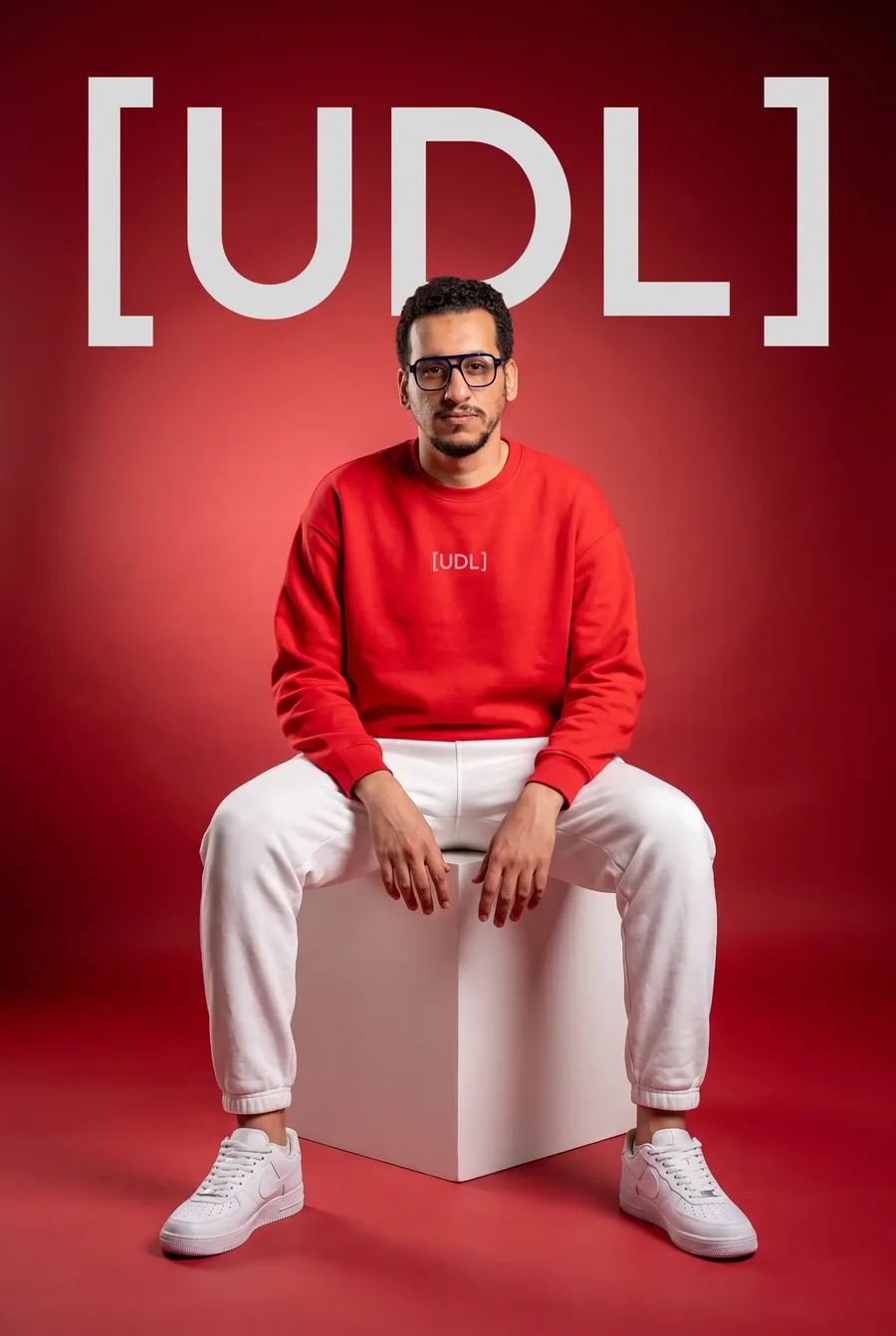
I am Ahmed Qurany, an Egyptian designer with more than 11 years and more than 500 projects behind me.
I have worked in graphics, presentations, branding and brand strategy, product design, animation, user experience, 3D, and building whole projects on the ground.
I am not saying that to impress you. I am saying it because it is the argument itself. The strongest work I have done did not come out of one discipline. It came out of knowing how to connect different ones and see the whole project. That is the thing I am saying still has a place.
I got there the hard way over years. UDL is an attempt to make that road shorter for someone else.

02What changed
Mastery in one discipline became a starting point, not an end
A while back I finished a course called The Ultimate Design Guide, 34 lectures on design fundamentals. After I finished it I felt it was incomplete. Not short on content. Short on something else.
The course taught you how to be a solid graphic designer, to the point that nothing in graphics would stand in your way. That was a complete and sufficient promise at the time.
At the same time the market was changing what that promise meant. Mastery in graphics alone became a starting point, not an end.
It used to be that someone who mastered one thing and did it well had a guaranteed road. Today ChatGPT makes social media posts and the results are pleasant enough for a client to accept. The need for the executor has dropped, and it is not coming back.
What a lot of people are not noticing is that the need for the specialist will drop too. Not because specialisation is pointless, but because AI sped everything up, so what is coming is people with many skills at once. What used to take years to learn as a second discipline now takes months.
So the designer standing in one lane gets squeezed from both sides. By AI on execution, and by another designer covering more ground than them.
03Track record
Who I have worked with
Clients include SABIC, NEOM, GACA, KAUST, Saudi Tourism, Matarat, Binzagr, Balubaid, Galaxy Racer, ADD, Sajilni, White Stone, IT-Ranks, Bexel.
More than 500 projects, from government bodies and large industrial companies through to startups still getting going.
That experience is not a substitute for a clear curriculum. But it is what lets us tell the difference between content that looks good and practice that actually changes how you work.
04The goal
What we are trying to build
The people who have those many skills.
A designer who works across more than one discipline, gives AI orders instead of taking them, and can defend every decision in their work.
This is not a designer who knows everything. This is a designer who understands how things fit together, so they do not stop at the edge of their discipline when the project asks for more.

05Methodology
Why UDL is not a course
The idea the whole of UDL stands on is that there is a difference between knowing something and owning it.
Knowing a rule in typography is about twenty hours. Owning it well enough to break it on purpose and know why is about a thousand.
AI reached the first and does it better than us, so the first is now worth nothing.
The second has no route except practice under review. Not content you watch. Work you hand in, that someone answers properly.
That is why UDL is not a course. There is nothing you finish in exchange for a certificate. Every space holds four things: a written and divided curriculum, an exercise that turns the idea into a decision, a submission where you explain your thinking rather than your output, and a response that shows you the gap so you can try again.
And badges are measured by proof from your work. Not by how many things you have seen or how long you have spent inside.
06Language
Why Arabic
Almost all the good material on design thinking is in English, and that creates a filter with no purpose. The Arab designer spends half their energy on translation before they even start thinking.
The explanation here is in Egyptian Arabic so the idea lands immediately, and the terminology stays in English exactly as we use it at work.
The goal is not to Arabise the field. The goal is to remove a pointless distance between the designer and the idea.

07UDL now
What growth will and will not do
12 spaces are open now out of a full map of 25, and that number grows every month.
What will not grow is the level of review. Work that gets handed in gets a real answer, not a quick comment, and that is what makes the place worth it. So growth will move at whatever speed protects that, and no faster.
Every space says clearly what is available, what is being written, and what is coming. Nothing is hidden.
Whoever comes in now comes in while the thing is still being built, and that has an advantage that will not repeat.

08Start here
So where are you in all of this?
24 questions, about ten minutes, all of them practical situations with no jargon from inside the curriculum. The result is not a score. It is a report on where you stand, what the gaps are, and which space to start from.